

Make • Modify • Move On
Make • Modify • Move On #525: Lattice Hat
Sep
Every time I spin the random number generator for Make • Modify • Move On, there’s a tiny moment of suspense.
With more than 1,000 knit and crochet designs in my archive, I genuinely don’t know what’s going to come up—or how I’m going to feel about something I designed years ago.
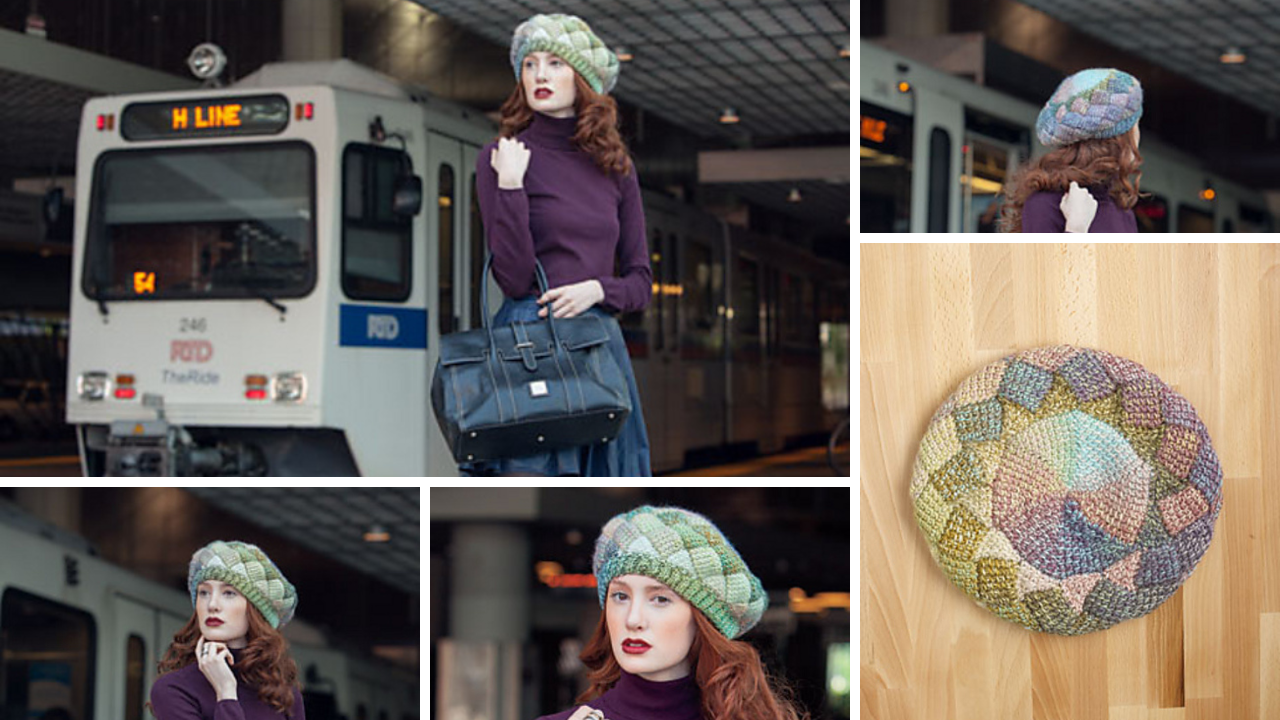
This time, the random number generator landed on #525: Lattice Hat, originally designed for Interweave Crochet magazine for the Winter 2014 issue.
And when I pulled up the photos, I had an immediate reaction:
Oh boy. Is this going to be a Move On?
Thankfully, no. 😂
There is actually quite a bit about this design that I still really like.
But there are also some things I would absolutely change if I were designing it today.
So the verdict for #525 is:
MODIFY
What I Still Love About the Lattice Hat
The first thing I still love is the modular construction.
The Lattice Hat uses Tunisian entrelac crochet to build the fabric in small interconnected sections. Instead of looking like one continuous field of stitches, the construction itself becomes part of the design.
And that’s something I still find really interesting.
I also like the way a self-striping or gradient yarn emphasizes that modular construction. As the yarn changes color, the individual sections become more visible and the geometry of the entrelac really comes alive.
That’s an idea I would absolutely keep.
And I still like the beret shape.
There’s a lot here worth saving.
So what’s the problem?
It’s the Yarn
If I were redesigning the Lattice Hat today, the biggest thing I would change is the yarn.
The original was made with a worsted-weight, roving-textured acrylic yarn.
Looking at it now, the resulting fabric feels heavier and stiffer than I would want for this particular hat.
And the crochet technique itself contributes to that.
Tunisian entrelac naturally creates a fairly dense fabric.
That’s part of its beauty. Those little blocks have wonderful structure and definition.
But when an already-dense technique is combined with a heavier yarn, the finished fabric can become too substantial—especially for something you’re going to wear on your head.
For a beret, I want enough structure to hold the shape, but I also want some softness and drape.
Those are two very different things.
How I Would Make It Today
I wouldn’t change the fundamental idea behind the Lattice Hat.
I’d change the materials supporting it.
Today, I would experiment with a sport- or DK-weight yarn instead of worsted weight.
I’d also choose a natural fiber or natural-fiber blend with a hand and drape that better complements the density of Tunisian entrelac.
And I would still want color to play an important role.
I don’t particularly love the original colorway anymore, but I do love what changing color does for this construction.
So I’d look for a beautiful gradient or slowly transitioning yarn that allows the modular sections to reveal the color changes organically.
Same concept.
Lighter fabric.
More drape.
Different fiber.
A color palette that feels more like me today.
Modify Doesn’t Mean the Original Was Wrong
This is one of the things I’m enjoying most about revisiting my archive. A Modify verdict doesn’t necessarily mean I think I made a mistake the first time.
I designed the Lattice Hat more than a decade ago for a magazine assignment. It belongs to a particular moment in my design career, with the yarns, colors, trends and opportunities available at that time.
But I’ve changed. My preferences have changed. My understanding of materials has continued to evolve. And if I’m going to bring an older design forward, I don’t want to simply reproduce it because that’s how I made it before.
I want to ask:
What would I do with this idea today?
For the Lattice Hat, the answer is surprisingly clear.
- Keep the Tunisian entrelac.
- Keep the modular construction.
- Keep the beret silhouette.
- Keep the idea of allowing a gradient yarn to showcase the individual modules.
- But lighten everything else up.
The Verdict: MODIFY
Make: The modular Tunisian entrelac construction and beret shape are absolutely worth revisiting.
Modify: Replace the worsted-weight roving acrylic with a sport- or DK-weight natural fiber or natural-fiber blend, and choose a new gradient colorway.
Move On: From the heavy, stiff fabric and the original color palette.
And I have to admit…
Phew.
For a minute there, I really thought #525 might become our first MOVE ON! 😂
Not today, Lattice Hat.
You’ve still got something.
About Kristin Omdahl

Kristin Omdahl is an author, designer, and lifelong maker with more than 20 years of experience creating crochet and knit patterns, books, tutorials, recipes, and creative projects. With more than 1,000 designs published worldwide, her work blends creativity, technique, curiosity, and a love of storytelling.
She is the host of The Kristin Omdahl Show, where she shares the creative process behind what she’s making, explores ideas and rabbit holes, revisits more than two decades of creative work, and finds inspiration in everything from yarn and color to recipes, math, travel, and everyday life.
Kristin is also the author of The Sea Glass Journal, a novel about creativity, self-discovery, and beginning again, set against the beauty of coastal living. Its world continues to inspire many of the recipes, patterns, projects, and stories she shares.
Explore The Kristin Omdahl Show, more than 1,000 knit and crochet patterns, tutorials, recipes, books, and more at KristinOmdahl.com.
WATCH THE KRISTIN OMDAHL SHOW on YouTube
LISTEN TO THE PODCAST ON SPOTIFY
GET EARLY ACCESS ON PATREON
