

Companion Journal, Crochet, The Sea Glass Journal
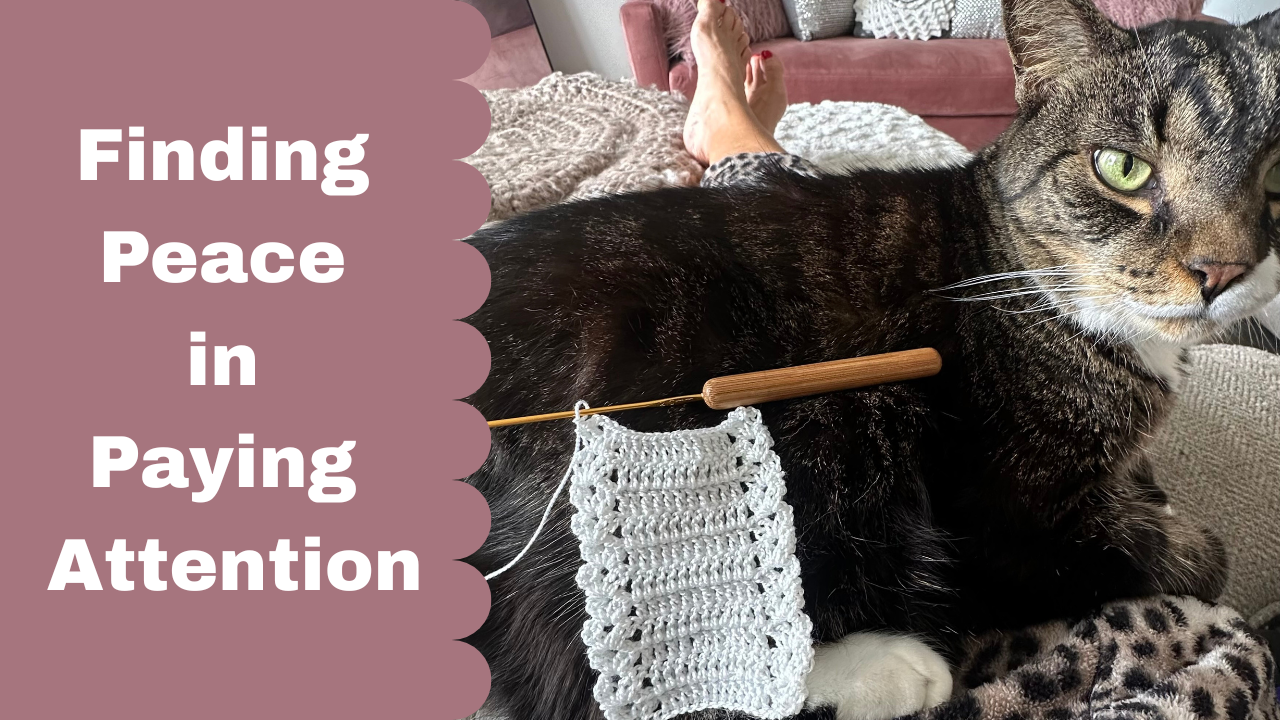
Finding Peace in Paying Attention
Jul
Finding Peace in Paying Attention
Over the past few months, I’ve been noticing a pattern that I didn’t expect.
At first, it seemed like a collection of unrelated interests. I’ve been spending evenings crocheting a garment with incredibly fine yarn and a tiny B/1 (2.25mm) crochet hook. I’ve been experimenting with sourdough recipes and keeping a starter alive on my kitchen counter. I’ve fallen in love with pickleball. I recently bought a packet of lettuce seeds, even though I live in a fourth-floor apartment and currently grow nothing but orchids. At the same time, I’ve been writing novels where baking bread, tending plants, cooking simple meals, and walking the beach have become just as important as the plot itself.
It wasn’t until recently that I realized these aren’t separate hobbies at all. They’re different expressions of the same thing. Somehow, each one has been helping me find a little more peace in a season of life that could just as easily be filled with stress, worry, and noise.
The common thread isn’t that they’re all slow.
The common thread is that they ask me to pay attention.
The crochet project I’m working on now has made that especially clear. For much of my career, I designed projects using thicker yarns and larger hooks. My hands knew what to do almost automatically. I could crochet by touch, glance across the room, watch television, or carry on a conversation while my fingers quietly continued making stitches.
This project is different.
Working with fingering-weight yarn and a tiny hook requires my complete attention. I have to look at every stitch. I can’t rely on muscle memory in quite the same way because each stitch is so small that it deserves my full focus. My eyes stay on the work. My hands move more deliberately. There simply isn’t much room left for my thoughts to wander somewhere else.
I’ve noticed something interesting because of that.
The slower my hands move, the quieter my mind becomes.
That surprised me because I experience something remarkably similar on the pickleball court, and there is absolutely nothing slow about pickleball.
When the ball is moving quickly, my brain doesn’t have time to replay yesterday’s conversations, worry about tomorrow’s problems, or mentally write endless to-do lists. All of my attention is focused on one thing: watching the ball, anticipating where it’s will go next, and responding in the moment. For an hour or two, the constant chatter in my mind becomes much quieter—not because I’m trying to silence it, but because my attention has somewhere else to be.
It made me wonder if what I’ve really been searching for all along wasn’t distraction.
Maybe it was absorption.
There is a difference.
Distraction usually helps me avoid my thoughts for a little while. Absorption gently replaces them with something meaningful. Whether I’m following a tiny crochet stitch, returning a pickleball, feeding my sourdough starter, or sitting quietly with a chapter of my next novel, my mind isn’t empty. It’s simply fully engaged with what is right in front of me.
The more I’ve thought about it, the more I’ve realized that almost everything I value seems to work this way.
A sourdough starter can’t be rushed. You feed it, observe it, and trust the process. Bread rises in its own time. Orchids bloom when they’re ready. Lettuce seeds don’t care about my calendar. Novels are written one page at a time. A handmade garment is created one stitch at a time.
Nature has never seemed particularly interested in hurry.
Perhaps that’s why I’ve been so drawn to it lately.
Nature has become one of my greatest teachers, not because it offers quick answers, but because it quietly reminds me that almost everything worthwhile unfolds gradually. I see it in the shells I collect on the beach, the orchids blooming in my home, the mangoes shared by a friend, the sourdough recipes I’ve been testing, and now in the tiny packet of lettuce seeds waiting to be planted. They all tell the same story in different ways: growth happens one small step at a time.
As I’ve been writing the Sea Glass novels, I realize those ideas have quietly found their way into the stories as well. Tess doesn’t rebuild her life through one dramatic breakthrough. She rebuilds it through ordinary rituals—mixing bread dough, preparing simple meals, walking the shoreline, tending plants, writing in her journal, and allowing herself to notice beauty again. When I first began writing those scenes, I thought they were simply details that made the story feel lived in.
Now I’m beginning to wonder if they were teaching me something, too.
There’s another piece of this that feels important to mention.
For most of my life, I found this same sense of deep focus at the piano. I began playing when I was eight years old, and for decades I rarely went very long without sitting down to play. After a wrist injury a few years ago, though, I stopped playing. This is the longest I’ve gone without regularly playing in my entire life, and I still miss it more than I expected.
Recently, someone offered a simple suggestion: don’t worry about playing difficult music yet. Just spend ten minutes a day practicing scales to gently rebuild strength and confidence.
I’ve thought about that advice a lot.
It isn’t really about scales.
It’s about giving myself permission to begin again without expecting to immediately be who I used to be.
Maybe that’s true of more than piano.
Maybe healing works that way.
Maybe confidence works that way.
Maybe creativity does, too.
One scale.
One stitch.
One loaf.
One page.
One seed.
I’ve spent a lot of years measuring success by what I finished. Finished patterns. Finished books. Finished videos. Finished projects.
Lately, though, I find myself appreciating something different.
I’m beginning to value the time spent making just as much as what eventually gets made.
The dress will eventually be finished. The bread will be eaten. The lettuce, hopefully, will grow. The novel will reach its final chapter.
Those things matter. But I’m starting to think the real gift isn’t the finished object at all. It’s the person we’re becoming while we make it.
Maybe that’s why these seemingly unrelated parts of my life no longer feel separate. Crochet, recipes, novels, gardening, pickleball, piano—they’re all inviting me to practice the same thing.
To notice.
To stay present.
To give my attention completely to this moment instead of scattering it across a hundred worries that may never happen.
I’ve spent much of my life creating things with my hands. Only recently have I begun to realize that those practices have quietly been creating something in me as well. And perhaps that’s where peace has been waiting all along. Not somewhere far away. Not after everything is finished. Right here, in the simple act of paying attention.